
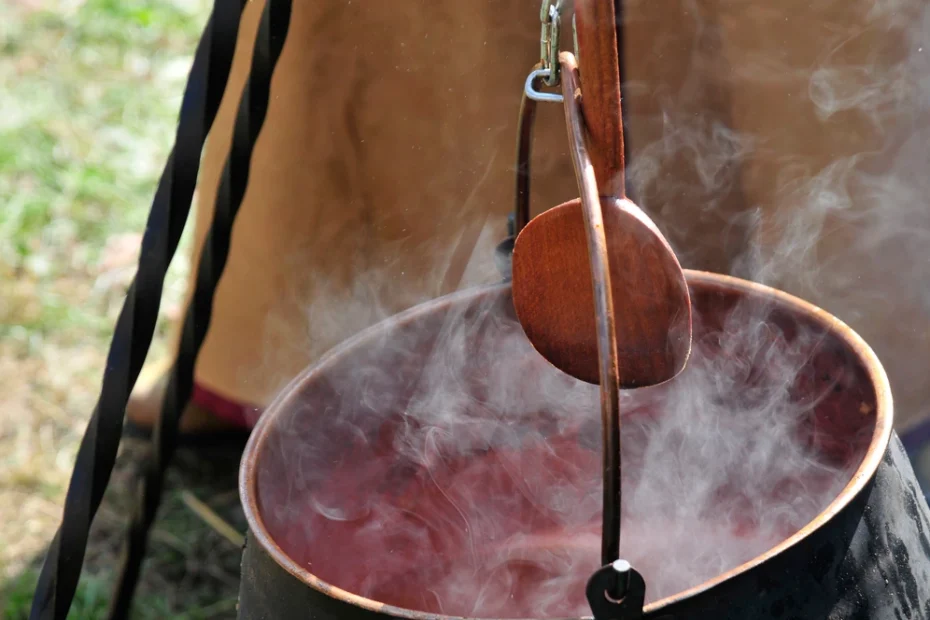
A comic aside to start with.
About 95% of the way through writing this post, looking up a link I wanted to include to an old one, I happened on this one from 2007. I’d entirely forgotten its existence. Ah, well. Nourished on ancient blog posts, perhaps?
Here’s a more in-depth version…
When I wrote about drinking wine in the Yi, I mentioned that its eating imagery seemed relatively simple. What you eat sustains you, you take it in, internalise it, partake of it… the food becomes part of you, you become part of the ecosystem and the social system: you’re participating. And if you’re not eating – think of 36.1 – then none of this is true.
The eating and drinking imagery works in the straightforward, direct way Yi’s imagery always does: here is a physical reality; imagine that, and you will understand. Imagine what it’s like to drink wine, or get your teeth into tough meat, or to be on the move and going hungry. You know the experience, feel your way into it, recognise it… and the reading resonates.
And then there’s the third line of Hexagram 6:
‘Feeding on ancient power and virtue.
Constancy: danger.
In the end, good fortune.
Maybe following a king’s work,
No accomplishment.’
‘Power and virtue’ translates de, as in the Daodejing (or Tao Te Ching) – the Classic of the Way and its Power. This is not something it’s physically possible to eat. And that’s so different from pretty much all the other imagery in the book that I wonder whether it might be a mistranslation.
How do you eat ancient de? Why does that lead to this complex mix of omens: danger with constancy, which surely means with persistence, in the longer term – but then also good fortune in the end? And what does it have to do with the king’s work?
So… I’m not finding this easy to understand, and it seemed like a good one to explore in more depth. I’ve had a look at some translators, at its place in Hexagram 6 and connection to Hexagram 44 (the one this line changes to) – here’s what I found.
Translators and traditions
‘Ancient’?
There are two different ways people take this: ancient and hence worthy of veneration, or ancient and hence stale and lacking vitality.
The only other appearance of the word (舊 jiu) in the Yijing comes in 48.1:
‘The well is muddy, no drinking.
Old well, no birds.’
That’s an ‘ancient’ well – plainly not one to venerate.
Does de need renewal and maintenance in the same way as a well? Maybe. However, the same word can mean something that is better because it’s old.
In Song 255, for instance, King Wen remonstrates with the Shang for their decadence and depravity:
‘Come, you Yin and Shang!
It is not that God on high did not bless you;
It is that Yin does not follow the old ways.’
The Chinese text simply says Yin (i.e. Shang) are not ‘using the ancient’. And in Song 256 there are ‘the ways of the ancients’ (which are true and good and abandoned by the foolhardy youngster), and the ‘glories of ancient times’ in 266. ‘Ancient’ evokes a golden age of virtue and alignment with heaven; the loss of these ancient ways has provoked heaven’s anger and brought down calamities on the people.
Looking at the dictionary, 舊 jiu just means old as opposed to newly made. Both meanings – ancient as in defunct, ancient as in ancestral, time-honoured and venerable – are present. The earlier uses do tend towards the positive, but the word in isolation seems neutral.
‘Power and virtue’?
De, on the other hand, is not so easy to define. (Perhaps about as easy as dao…) It means the nature of a person or thing, their character, and also ethics and moral conduct. The Chinese character de 德 has elements representing a road, a heart, and an eye that looks along a straight line 直 – like someone using a taut string to build a wall straight – meaning straight, not crooked, in both the physical and moral sense.
De isn’t ‘virtue’ as in abiding by all the rules, but a form of power: what works. A house with straight walls is more robust; an honest person is stronger. An effective leader or great sage has de – moral potency, dao in action.
So to eat ancient de is to fuel oneself on ancient moral potency, perhaps finding inspiration and motivation there, like British people evoking ‘Blitz spirit’ to get through Covid lockdowns.
Or perhaps it isn’t.
Rutt’s translation of the line begins, ‘Eating stale forage.’
And in Minford’s Book 2 it’s ‘Old game eaten’, while Field has, ‘He lived off old bounty.’
Field explains:
“The word that means ‘bounty’ is usually translated as ‘virtue’, which is its fundamental sense. However, in Zhou dynasty texts the character is sometimes semantically equivalent to another character with the same pronunciation, meaning ‘to get’. That is the case here and with other instances of the word in the Zhouyi.”
That would explain the un-image-like imagery of ‘eating’ an abstraction: it was never meant to be an abstraction at all.
How well does this work for the other instances of this word in the Yi, though? They’re at 9.6 (after the rain, ‘honour the de it carries’), 32.3.5 (‘(not) lasting in your de‘) and 42.5 (‘truth, confidence and benevolence are my own de‘). To my mind, those all make a lot more sense with de as moral power and energy than as anything someone ‘got’. There’s the energy contained in the earth after rain, the power that comes from being your own self, and 42.5 especially sounds very much like the de that is the quality of a leader or sage.
Also, that other character also pronounced de and meaning ‘to get, gain’ is used regularly in the Yi, as a verb, with an object, meaning ‘to get’. (23.6, for example: ‘the noble one gets a cart’.) It’s plainly a different word.
So I don’t believe the answer to ‘how do you eat virtue?’ is ‘you don’t, you only eat game’. However, that translation would make the line hang together quite well, with the lack of accomplishment in the king’s service. If you can’t get anywhere now, you can only live on dried meat, or on whatever payment you’ve saved up from back when you did get credit.
I wonder whether there might be a hint of word-play here, with the authors deliberately allowing both meanings. Nourish yourself on what was gained in ancient times, or on an ancient store of energy and potential. That would make this de – its first appearance in the book – a lot like the de stored up after rain in 9.6. Then the idea can evolve into something more clearly a personal quality later in the book, in hexagrams 32 and (especially) 42.
Ancient power Arguing
Trying to understand a line of the Yi in isolation, away from its context in the hexagram, is never a good idea. So… what’s the basic situation of Hexagram 6 that this line is grappling with?
‘Arguing.
There is truth and confidence, blocked.
Vigilant and centred, good fortune. Ending, pitfall.
Fruitful to see great people,
Fruitless to cross the great river.’
First and foremost: truth and confidence, fu, is blocked.
‘Blocked’ means stopped up, like a blocked hole or a stuffy nose. And fu is truth, trust, sincerity and confidence: the meeting of trustworthiness with trust, and how this creates a channel of connection between people, and between people and spirits.
With fu, you are in harmony with the Way, you can trust your environment, knowing you are part of it and you belong. It’s foundational for Hexagram 5, Waiting, the pair of Arguing. Waiting has fu; Arguing has blocked fu. Arguing, says the Zagua, ‘means not connecting’.
Then comes an ‘arguing’ series of contrasts: good fortune vs pitfall, fruitful vs fruitless. It’s this initial condition of blockage that means you need to be vigilant (literally alert to change, ‘heart’ + ‘yi’), balanced, open to advice. In all this, you will be re-opening yourself to be present to the whole truth, re-aligning yourself with reality, trying to recapture or recreate your fu. Never cross rivers without it!
The third line of the hexagram is at the upper edge of the inner trigram – just where the water falls away from heaven. Line theory tells us that it’s in resonance with line 6 (because that one’s yang and this is yin), so it’s both reaching upward and plunging downward, as water does. It seems this line might feel the tension and disconnection of Arguing especially strongly.
‘Feeding on ancient power and virtue,
Constancy: danger.
In the end, good fortune.’
That’s the opposite of what the Oracle text said – ‘vigilant and centred good fortune, ending pitfall.’ ‘Ending’ and ‘in the end’ are different translations of the same Chinese word.
In context, in the Oracle text, ‘end’ doesn’t seem likely to mean only ‘after some time has elapsed’ – that would undermine the point of the contrast with ‘vigilant and centred, good fortune.’ For me, it implies sticking with something through to its natural end point – so that ‘ending, pitfall’ means something like, ‘it’ll all end in tears.’
So… I think this is a deliberate echo of and contrast with the Oracle text. Pig-headedly holding your position ends badly, but nourishment on ancient de changes the outcome.
Meeting Hexagram 44
When hexagrams are joined by changing lines, I ask myself how they might fit. If there were something 44-ish about Hexagram 6, what could it be?
‘Coupling, the woman is powerful.
Do not take this woman.’
That – the woman who is not to be married – sounds to me like not connecting. She’s powerful, but not marriageable. It wouldn’t last, according to the commentary on the Oracle.
If Hexagram 6 has a 44-ish moment, it could be the one when I find that things are really not under my control and not working the way I wanted them to. Here is a tremendously powerful energy that I can’t integrate and make use of in my life.
And… the woman’s power that can’t be married seems to me very reminiscent of the ancient de that doesn’t produce results in the king’s work. Neither power is exactly compatible with The System. (And if this association – the powerful woman of 44 and ‘ancient virtue’ – gives you a jolt, don’t forget that de is power, efficacity, not just virtue, and also that 44’s Oracle simply describes the woman as powerful and unmarriageable; it doesn’t say there is anything wrong with her.)
So we have a basic incompatibility, a square peg and a round hole. Ancient de just does not fit with the immediate demands of the king’s work. If that’s what nourishes you, you needn’t expect to be rewarded now. You’re going to have to rely on that ancient virtue, fall back on your savings and hope they last you.
In individual readings, this picture often gives rise to natural value judgements about which should take priority, ancient virtue or current recognition. Sometimes eating ancient de looks like having the courage of your convictions, sometimes just like obstinacy and a failure of imagination. I think the line allows for either possibility. But whether it tastes of ‘ancient virtue’, or ‘stale forage’, there does always seem to be this core of incompatibility.
Walking round the line pathway
The line pathway can help us get a look at a line from some different perspectives. It starts with ‘What if we were coming from the other direction?’ – from 44 to 6?
‘Thighs without flesh,
Moving awkwardly now.
Danger.
No great mistake.’
And then we invert the whole thing, walk right round to look at the hexagrams from the other end (or turn them upside-down, if you prefer), and find ourselves looking at 43.4 to 5 –
‘Thighs without flesh,
Moving awkwardly now.
Lead a sheep on a rope, regrets vanish.
Hear words, not trusted.’
and 5.4 to 43
‘Waiting in blood.
Come out of the pit.’
More interesting imagery! And you can see how 44.3 and 43.4 are ‘paired lines’, sharing the same image.
It’s likely that those ‘thighs without flesh’ belong to Yu the Great, the Chinese flood hero. Yu built no boats; he laboured over the course of years to build dams and dig channels so that the waters could flow out to sea. The story goes that he spent so long wading through the waters that his thighs wasted away and he developed a limp.
In the trigrams of Hexagram 6, the waters rage under heaven. (They may be telling flood stories, too.) In 43 the dam bursts; in 44, the unpredictable and uncontrollable breaks through. When the floods come, dams burst and the water escapes from its natural channels. (It turns out that the myth and the hexagrams are a very accurate reflection of China’s real flood story.) This is not something to float over in an Ark – it calls for work to bring the world back into harmony.
The ancient de – ancestral spiritual power – of Yu the Great is to tame the waters and re-open the channels. In other words, or so it seems to me, it un-blocks the fu, the truth and confidence, that is blocked in Hexagram 6.
The fan yao often tells you how your cast line might feel. Here, there is the ancient virtue of Yu, and an echo of ‘danger’ to reinforce that. Being constant in trying to embody Yu’s power might leave you feeling like your thigh muscles are wasted away, and making progress is harder than ever. It took Yu thirteen years to conquer the floods; if you’re working for the king, he might expect results more quickly.
And on the other side of this coin, in the fourth lines, there could be a solution: to come out of the besieged city and surrender; to come out of the pit. The hidden need – in the line, 44.4, that’s furthest away from 6.3 – seems to be to bridge the gap, make a connection somehow, even if you need a sheep.
Conclusions?
Speaking of ancient de… here’s what I wrote back in 2007:
“So receiving this one, you might look at the ways your internalised ‘ancient de‘ is affecting your immediate results. Can you afford to wait for the ‘good fortune in the end’, or do you need something tangible to show the ‘king’?”
I’d still hold to that. This is one of those lines where we tend to think there must be a message in here about the right way vs the wrong way. ‘Ancient’ must mean either ‘venerable’ or secondhand, stale and morally lazy. The king has to be either the representative of a highest good, or a political time-server who represents only shallow expediency.
Only, as often happens, none of these moral judgements is to be found in the original. Sometimes you will receive this line and understand that holding to your original principle and knowledge is the right thing to do, and you don’t need the recognition anyway. And sometimes you will see the danger of being left hungry and exhausted and feel the need to re-evaluate and refresh your de to meet the new situation. The line only points to that fundamental incompatibility of ancient de and present-day demands, and leaves the choice to you.