

Introducing ming
I’ve started exploring an interesting word in the Yi, one of those that’s so heavily freighted with Deep Significance that it can be hard to know what to do with it.
Ming 命 – ‘mandate’ (amongst other things) – occurs in 6.4, 7.2.6, 11.6, 12.4, 49.4, 56.5, where it has many different translations. In Wilhelm/Baynes, it’s ‘fate’, a ‘decoration’ (from the king), ‘commands’, ‘the form of government’, and ‘office’. How can a single word mean all these things?
Here it is:
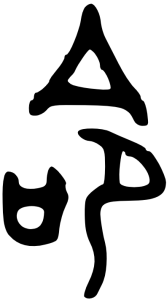
A mouth (probably) is calling down to a kneeling figure – this part of the character is ling, ‘to give orders’. During Zhou times, scribes started adding the mouth at the bottom left to differentiate ming from ling.
The dictionary defines this as orders, to command someone, to give them a mission or responsibility. To receive or accept ming from heaven is to be invested with authority and become a successful ruler; the ruler himself also issues ming that are royal decrees and come with official insignia.
From here, the word has also developed more philosophical/metaphysical meanings: your lifespan, your lot in life, the fate bestowed on you by heaven; also your innate qualities, the gifts bestowed on you by heaven, and the concomitant duty to fulfil them.
A very useful English word to capture this idea is calling – and this is also a very good fit for that ancient character with its mouth speaking to the figure below. ‘Your mission, should you choose to accept it…’ (You should.)
The Mandate of Heaven, 天命
The concept of a Mandate of Heaven, tianming, seems to originate with the Zhou – the people who crafted the Yi. According to this idea, kingship is not an innate right; it is a calling from Heaven. To be worthy of such a calling, the ruler must be virtuous, and govern justly and well. If he is incompetent or corrupt, he will forfeit the Mandate, and there will be signs – celestial omens, natural disasters – indicating the loss.
The clearest sign of all would be a successful rebellion. If a people have overthrown the old regime and founded a new one, then by definition the Mandate of Heaven must have passed to them – without it, they would have failed.
The Tuanzhuan – the Commentary on the Oracle – of Hexagram 49 lays it out:
“Tang and Wu changed the mandates
Bradford Hatcher’s translation
Complying with heaven while resonating with humanity.”
Wu (son of Wen) overthrew the Shang. Tang was the first Shang ruler, who established their dynasty by overthrowing the Xia some 550 years before.
It’s essential to pay constant, careful, humble attention to the signs of this Mandate, and not presume. King Wu, after gathering all the armies in the Wilds of Mu, read the signs (Jupiter turning retrograde, according to Pankenier in Astrology and Cosmology in Early China) and insisted on turning back, in the teeth of his generals’ eagerness to advance. ‘You do not know Heaven’s Mandate,’ he told them. ‘It may not yet be done.’ And even when you have received the Mandate, it could still easily be lost – an idea I think is reflected in Hexagram 63’s anxiety about chaotic endings.
However… tianming, the Mandate of Heaven, doesn’t actually get a mention in the Zhouyi (the oldest layers of the Yijing text) – only ming. So not every occurrence of the word has to be weighed down with the full meaning of heaven’s mandate. Perhaps some of them are simply ‘orders’?
For comparison, we can look at the inscription on this bronze vessel, the Da Yu Ding, which is more or less contemporary with the Yi itself. The word ming appears here several times, and the translation shows its range of meanings: the Mandate of Heaven, as forfeited by Yin (the Shang) and received by Zhou, but also the detailed ‘charge’ that the king is making to his subordinate Yu, who casts this vessel to record it – and, perhaps, to ensure Heaven will hear about it when the inscribed vessel is used for offerings.
So even on this most solemn occasion, the casting of a great bronze vessel, not every ming comes direct from heaven. In the Yi, in readings (which are for any and all occasions!), we have to allow a broader meaning: calling, what you are charged to do, your responsibility.
Could ming be trivial, everyday ‘orders’ – the latest unreasonable email from the boss? Perhaps. But it’s worth noting that the Yi does have different ways to describe this: the ‘charge’ embraced in 12.2 (Bradford Hatcher translated that firmly as ‘servitude’), and ‘affairs’ or ‘work’ (not least when it’s ‘the king’s work’, as in 2.3 or 6.3). I don’t think ming will ever just be the prosaic ‘stuff you have to get done’.
Instead of arguing: 6.4
‘Cannot master this argument,
Returning and taking up the mandate.
With a change of heart, peaceful constancy is good fortune.’
In its first appearance, we get to understand mandate by seeing what it isn’t: the unwinnable argument. When you can’t win, you turn yourself around (this is the same ‘return’ as the name of Hexagram 24) and take up the mandate.
This amounts to, or calls for, a ‘change of heart’ – something I’ve written about before): this line is one vertex of a triangle of ‘changes of heart’, along with 16.6 and 17.1.
‘Enthusiasm in the dark.
Results bring a change of heart,
No mistake.’
‘An official has a change of heart.
Constancy, good fortune.
Going out of the gates, joining with others, there is achievement.’
A ‘change of heart’ can come from encountering results after a whole hexagram of anticipation, or from going out of the gates from the confines of your official seat – or from turning away from the argument. In each case, it seems to be a change towards something bigger and more real.
It’s also interesting to compare this one with line 2:
‘Cannot master this argument,
Return home, escape to your town’s people,
Three hundred households.
No blunder.’
Recognising the unwinnable at an earlier stage, back at line 2, you turn back towards familiar relationships and can at least avoid the blind stupidity of fighting a losing battle. But line 4 has an actively positive omen: with peaceful constancy, good fortune. How come?
Where second lines tend to be focussed on relationships, fourth lines, just across the boundary between trigrams, tend to ask, ‘What can I do here?’ Asking this question mid-argument means learning very thoroughly that no, you can’t win this, but here’s how you can be at home in life (‘peaceful’, an 安, originally shows a woman under a roof) in a quiet, steady way: by turning back to your mandate. By definition, it’s the perfect opposite of an unwinnable argument: what you can do, because it is exactly what’s yours to do. While only line 5 of Hexagram 6 can win the argument, line 4 enjoys good fortune from not winning.
This line changes to Hexagram 59: it’s Arguing’s moment of Dispersing. Why can’t you win? Perhaps you are arguing with the floods: not much future in that, as King Canute demonstrated. Or perhaps the position you were fighting for loses definition by itself. The win/lose binary dissolves, the flow of spiritual energy is no longer blocked (its default state in Hexagram 6), and you can rejoin it by settling peacefully into your calling.
(Six more examples to come…)