
You can browse ‘hexagrams of context’ in the dedicated tab in the hexagram browser window:
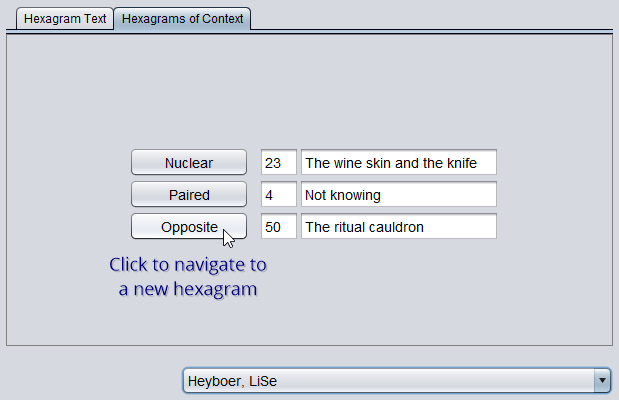
They’re also mentioned in the advanced search window, cast history search and Yijing reading cast tab (below the translation and commentary).
Primary hexagram #
This is the original hexagram you cast. The answer to your question starts here.
Relating hexagram #
The hexagram that appears when all moving lines have changed to their opposites:
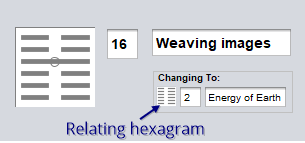
The role of the relating hexagram varies, but expect it to tell you something about where you stand relative to the whole.
Nuclear hexagram #
A hexagram created from the inner lines of an original hexagram. A hexagram’s lines are numbered 1 through 6 from bottom to top. To find its nuclear hexagram, you create a new hexagram from lines 2,3,4,3,4,5.
For instance, here’s Hexagram 50, the Vessel, and its nuclear hexagram 43, Deciding:
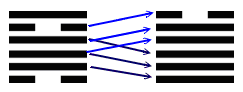
A nuclear hexagram describes a core reality that’s manifest in the original hexagram: the Vessel is one way that Deciding becomes manifest.
Paired hexagram #
Each odd-numbered hexagram is paired with the even-numbered hexagram that follows: 1 with 2, 3 with 4 and so on.
Most hexagram pairs are created by inversion – Hexagram 4 is the same as Hexagram 3, just upside-down. Hexagrams that don’t change when inverted are paired with their opposites.
The paired hexagram shows you the ‘other side of the coin’.
Opposite hexagram #
The hexagram created by changing all six lines; also known as the ‘complementary hexagram’. The opposite of Hexagram 50 is Hexagram 3, Sprouting:
| Hexagram 50,
the Vessel |
Hexagram 3,
Sprouting |


Opposite hexagrams show you exactly what your answer isn’t – and can also show what’s needed for balance.
Patterns of change #
The patterns of change are ‘map’ hexagrams showing only where a line is changing. In the yang pattern of change, each changing line is represented by a solid (yang) line and each unchanging line by a broken line. The yin pattern of change is the reverse: changing lines are represented by broken (yin) lines, unchanging lines by solid lines. Hence yin and yang change patterns are opposite hexagrams.
The patterns of change can describe a path through the reading. The yang pattern tends to describe how you encounter or enter the moment of the reading – it may be immediately recognisable as such. The yin pattern may show a way through. It can be helpful to reflect on how to attain an equilibrium between the two.
Steps of change #
The step of change (or zhi gua) for each line is the hexagram created by changing that line alone – it will be the relating hexagram if only that line is changing.
In readings, they can be considered as a miniature relating hexagram for each changing line.


