
Should I go after him?
Joanne had met a wonderful man on her travels. Love at first sight, promises exchanged… and then she had to go home, and he – he said – had to stay for a while to raise some money before he could move to be with her. Stay, that is, with the woman he was currently involved with.
Back at home, without his reassuring presence – as you might expect, the voices of doubt crept in, and she seriously considered travelling again to see him, and try to get him away from this woman. But first she asked the I Ching for advice.
The oracle gave her Hexagram 60, Measuring, changing to 29, Repeating Chasms. That second hexagram captured how she felt – falling into a dark chasm, with nothing solid to hold onto. In such danger, the I Ching says, ‘with truth and confidence, holding fast your heart creates success.’
Hexagram 60, meanwhile, is about the boundaries and mutual agreement that create any relationship. ‘Bitter measures do not allow for constancy,’ it says. What were the ‘bitter measures’? His expectations, or her own? Should she go?
On to the moving line:
‘Not going out of the door to the family rooms. Not a mistake.’
How much clearer could it get? Staying at home certainly felt wrong, but it was not a mistake. She stayed put, preserved her dignity and showed some trust in him – and he kept his word to her.
(This reading was published in I Ching Made Easy by the Sorrells – a very good source of examples!)
Some Clarity history
I launched the first version of the Clarity website in 2000, so I have plenty of readings from its early years that I can enjoy reading now with benefit of hindsight. In around 2000 or 2001, I’d started ‘Friends’ at my newly installed forum, where I would give people readings – and in return, asked that they give back as much or as little money as they saw fit, or offered help to other friends.
It was going well, in the sense that lots of people signed up and I spent many hours doing readings that many people were very happy with. Only… two people out of about 55 had paid anything, and maybe four had given help, and this was starting to get me down…
…in fact, I was feeling horribly sorry for myself, and was starting to compose in my head a nasty, complaining ‘poor me’ sort of email to send to all the ‘Friends’. But fortunately I had just a sliver of self-awareness left, and asked Yi for advice first.
Hexagram 58 – Opening – unchanging. Joyful communication, sharing, open exchange, the persuasive power of joy, the noble one who ‘joins with friends to speak and practise together.’
This was not the whiny email I had in mind. It wasn’t ‘putting a bomb under them,’ as a friend had suggested, either. Conversation with Yi is a thing of joy – and I love doing readings. (A lot has changed since 2001; that hasn’t.)
I rewrote the email… twice (Yi’s comment on my first rewrite was hexagram 18 – ‘deal with corruption!’)… so that in its final version it simply explained how happy encouragement made me. And there was a modest but encouraging response – one donation, one beautiful, wise interpretation posted for someone who needed help. But I still needed more reassurance. Should I, I wondered, devise some kind of formal system of payment for I Ching Community membership?
Question to Yi: Where next with Friends?
Yi’s answer: Hexagram 42, Increase, changing at line 5 to Hexagram 27, Nourishment.
Some answers are enigmatic; it takes time, curiosity and imagination to understand them. Others are so clear I’m rocked back on my heels by them. It feels as if the oracle’s saying, ‘You really need this spelling out? OK, watch my lips while I explain very – slowly – and – clearly…’ And this was one of those ‘Yi explains to the village idiot’ moments.
Hexagram 42 –
‘Increasing, fruitful to have a direction to go.
Fruitful to cross the great river.’
There’s the image of pouring in more to a vessel – the increase in everything good that comes from giving. It basically says – move forward, explore with a purpose, commit yourself, give more.
I also love the little snippets from the Great Treatise on this hexagram – that it ‘probably’ inspired the invention of the first farming tools, that it means ‘long-living enrichment without contrivance.’ Elaborate schemes and systems are fundamentally not required – just responsiveness:
‘Wind and thunder. Increasing.
A noble one sees improvement, and so she changes.
When there is excess, she corrects it.’
One of my favourite ‘common sense that isn’t common’ moments, that – seeing what needs changing, and changing it. Such little adjustments could be the key to staying in the flow, to tapping into Increase.
In the background, Hexagram 27, Nourishment, is a wake-up call. ‘See the jaws, and your own quest for something real to fill your mouth!’ Suddenly this hexagram –
– looked to me like the gape of a squawking fledgling. ‘Feed me! Feed me now!’ Sometimes I felt like the mother bird, dashing to and fro to fill the incessant need – but I could also recognise myself as one of those little bundles of hunger that seem to be about 90% mouth. What was I feeding to people? What food did I need – and was I looking for it in the right place?
And the heart of the reading, the moving line:
‘True and confident, with a benevolent heart,
No question: good fortune from the source.
Truth, confidence and benevolence are my own strength.’
It felt – and feels – like something between reassurance and a challenge. If I have true generosity and goodwill, if this is my essential nature, then there is no question to ask at all. Of course generosity brings good fortune from the source – what else could it do? Hmm… so if there is no question, why did I ask one? Because – heh – my own strength is not quite so pure and clear as the ideal embodied in this line. But it does show me how this works, where good fortune comes from.
So the I Ching Community has stayed free and simple, even as other offerings grew around it. And it’s Increased in ways I couldn’t have imagined at the time – thousands of members, countless thousands of readings given and received ‘without contrivance’. Actually… looking at this now, I half-wonder who is speaking in the line, saying ‘Truth, confidence and benevolence are my own strength.’ Could that be the spirit of the Community itself?
Chu Hsi’s retirement
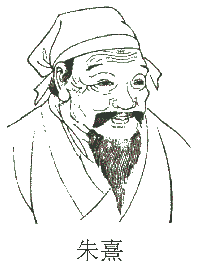
Chu Hsi lived under a hostile regime, but persisted in voicing opinions and publishing books that went against the prevailing orthodoxy. In 1195, he wanted to bring out another book; his friends wanted him to play it safe. They persuaded him to consult the I Ching for advice.
The oracle answered with Hexagram 33, Retreating, changing to Hexagram 37, People in the Home: literally, Retiring (33) to be with his family at home (37). Hexagram 33 described how he could gain from adapting to the time and retreating from the situation. His opponents, it implied, were ‘little people’ whom he would do better to keep at a distance, rather than getting emotionally involved in antagonism.
Line 1 changing speaks of the danger of being late to retreat, like the tail of a fleeing animal is closest to the predator’s jaws:
‘Retreating tail, danger. Don’t use this to have a direction to go.’
So it wasn’t the right time to pursue his own purposes. The fourth line showed what a wise man would do: ‘loving retreat’, retiring gracefully, frustrating his enemies and their pettiness.
Chu Hsi had always maintained that the I Ching’s true purpose was found when people consulted it and incorporated its advice into their lives. He burnt the book that would have brought him into danger, and retired safely. He died in 1200AD.
Lost wallet panic
Rod and Amy, authors of The I Ching Made Easy, were staying in Kathmandu, and during an unbelievably chaotic and hectic day, he lost his wallet – containing all his money, his credit cards, passport – everything. Panic…
They asked the I Ching what to do: was there the remotest chance of getting it back, or should they be hurrying to cancel the credit cards and get a new passport?
The answer was Hexagram 63, Already Forded, changing to Hexagram 5, Waiting. Waiting for what they needed was exactly what they were doing; the hexagram said they should do this calmly and cheerfully – hmmm… Hexagram 63 says, in essence, that everything is already perfectly in place.
And the moving line – ‘The wife loses her veil. Don’t pursue it. In seven days, gain.’ The answer to their question could hardly have been clearer, though they couldn’t be sure how soon they would see the wallet again – ‘seven days’ generally means ‘in due course’. In fact, their taxi driver brought the wallet to their hotel that evening, with its contents intact.
Can this relationship have a future?
Rod and Amy had been together for ten years, but they had very real doubts about how much longer this could last. He was going through a turbulent time personally, questioning his own values. Could they seriously be expected to create a relationship, when it was hard enough just to cope with themselves?
The answer was Hexagram 40, Release, changing to Hexagram 64, Not Yet Across. Again, the relating hexagram describes the present atmosphere: not quite sure about the commitment, like a little fox not quite confident about crossing the river. Everything should be perfect (shouldn’t it?), but everything feels wrong. Release was what they needed: it speaks of dissolving tension and breaking bonds, turning back from paths with no goal, but pursuing your real goals with vigour.
What bonds were these they needed to break? The advice from the Image speaks of forgiveness, letting go the rules with which we make nets to trap one another. Maybe this was about releasing the expectation that everything should be perfectly ordered, and allowing the confusion to work itself out?
The moving line shows a dramatic image of a prince who looks up at the bird of ill-omen looming on the walls above him, and shoots it down. Then there is ‘nothing that does not bring harvest.’ It’s a picture of someone aiming directly at their problems and conquering them. They did – and that relationship is still going strong.
“What about my drive to bring spiritual practices into psychoanalytic therapy?”
This example’s drawn from the groundbreaking I Ching by Rudolf Ritsema and Stephen Karcher (out of print, but this is almost the same book), but with text from my own book.
A young doctor, training in psychiatry, found that his deep spiritual convictions were bringing him into conflict with his supervisors. He was driven above all to help people by giving them a sense of spiritual meaning, and felt increasingly indignant at the narrowness of his training. His supervisors said he was being ‘unscientific’ and should keep his personal convictions to himself. As the conflict and pressure built up, he asked,
‘What about my drive to bring spiritual practices into psychoanalytic therapy?’
Yi answered with Hexagram 4, Not Knowing, changing at the sixth line to Hexagram 7, the Army.
(…You could try pausing here to look up the answer and see what you would have said to the trainee doctor…)
As so often, the second, relating hexagram is immediately recognisable as the questioner’s world. He is moved by his reaction against the situation, just as the Army is propelled into action by Hexagram 6, Arguing:
“‘Arguing naturally means that crowds rise up, and so the Army follows. The Army means crowds.’
First you react with indignation against the status quo; then you begin to organise a way to change it. ‘Crowds’ of people, energies and resources gather around that original focal point of grievance. The emotions that began as mere indignation and reaction can now become an inner reserve of strength.”
(Only the part in italics there is from the Yijing itself; the part in plain type is from my comments on the Sequence.)
He has powerful focus on a single objective, like the Army, and he has the will to act on this unsatisfactory situation and bring about change.
So here is the picture of that ‘drive’ he asked about. Reading both the Oracle and the Image for the relating hexagram will give him some hints as to how best to handle it.
‘The Army: with constancy.
Mature people, good fortune.
No mistake.’
‘In the centre of the earth is a stream. The Army.
A noble one accepts the people and gathers together crowds.’
It is good to be constant, to act like an adult; it is good to be accepting – accepting? – in order to gather support. This does not sound easy.
Meanwhile, the primary hexagram reflects his immediate experience. He has been asking and asking for a better response from his teachers, and not receiving anything like the response he wants:
‘Not knowing, creating success.
I do not seek the young ignoramus, the young ignoramus seeks me.
The first consultation speaks clearly.
The second and third pollute the waters,
Polluted, and hence not speaking.
Constancy bears fruit.’
These lines could be words in his teachers’ mouths: they didn’t seek out his opinion, and his repeated approaches have muddied the waters of their relationship. And also, perhaps these could be words coming from the cosmos as a whole – he has asked and asked for the change he seeks, but has he got any clearer himself on the way forward?
Of course, this all casts him as the ‘young ignoramus’, the one who does not know!
The Image suggests an alternative approach, and the only way a situation of Not Knowing can possibly evolve:
‘Below the mountain, spring water comes forth. Not Knowing.
A noble one nourishes character with the fruits of action.’
So it’s not about getting a certain response from other people; it’s about the fruits of action…
And for the most direct comment, he looks to the moving line:
‘Striking the ignoramus.
Fruitless to act like an enemy,
Fruitful to resist enmity.’
Now his ‘drive’ appears as something aggressive and violent – an attack, directed at his own experience of ‘not knowing’ and not being able to see how the change can happen. The advice here is clear and firm: it would be fruitless to become anyone’s enemy.
He understood the reading as advocating patience and a yielding spirit, and as a sign that he had some growing to do. This was a time not to know, but to learn, allowing development so his ideas could bear fruit later.
