

 .




Clarity,
Office 17622,
PO Box 6945,
London.
W1A 6US
United Kingdom

myanon0001
visitor
- Joined
- Nov 3, 2014
- Messages
- 27
- Reaction score
- 2
Would someone please help me solve this conundrum? ...
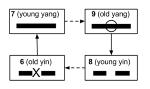
On the one hand, to state the obvious: Every line statement in the Zhouyi apparently begins with a reference to either 6 or 9 in the given place; e.g. "Nine at the beginning", etc. So evidently a line statement does not apply unless indeed 6 or 9 occurs in the given place, i.e. it is a changing line.
On the other hand, in some prominent methods of interpreting the oracle (including that of Zhu Xi), when there are 5 or 4 (or in some cases 3) changing lines, the main prognostication is a line statement that corresponds to an unchanging line, usually taken in the relating hexagram.
So the question is, How does one justify taking text explicitly reserved for a changing line and nevertheless applying it to an unchanging line?
Perhaps related to this, I've noticed that various Yijing translations differ with respect to whether 6/9 is in fact mentioned in each line statement. E.g., instead of "Nine at the beginning" (Wilhelm-Baynes) or "1. In the first NINE" (Legge), some have merely "1." (Richter) or "First yang" (Huang), etc.
So a related question is, Are there authentic ancient versions of the Zhouyi that do not explicitly mention 6/9 in the line statements?
Last edited: