|
|||||||
| Exploring Divination For discussion of all kinds of divination (not just the I Ching). Not for sharing or requesting readings - those go in 'Shared readings'. |
![]() |
|
|
Thread Tools | Display Modes |
|
#51
|
||||
|
||||
|
BTW, Karlgren's is not a super-duper dictionary. Difficult to find, about 300 pages of hand written Chinese characters and their glossing. Mine is almost falling apart from old age and a bad spine. Now, you go and ask Harmen or LiSe, since they are both in The Netherlands as yourself, to toss Karlgren to the dustbin. For all the personal opinions Harmen may have on it, I'm sure he wouldn't depart from his possession.
L |
|
#52
|
|||
|
|||
|
Erhm, well, I just had a 'Burn Karlgren to the DustBin' ritual. Which is also a 'bin' ritual, just like the Shang had. But seriously, of course I would never throw Karlgren's GSR away, but I hardly ever consult it. It is outdated, and when it comes to the original meanings of ancient characters it is not always reliable. I have far better sources which I consult every time. Kalgren made a mile stone with this book, just as Wilhelm did with his Yijing. But both books are a rooted in their time with all the consequences that come with that.
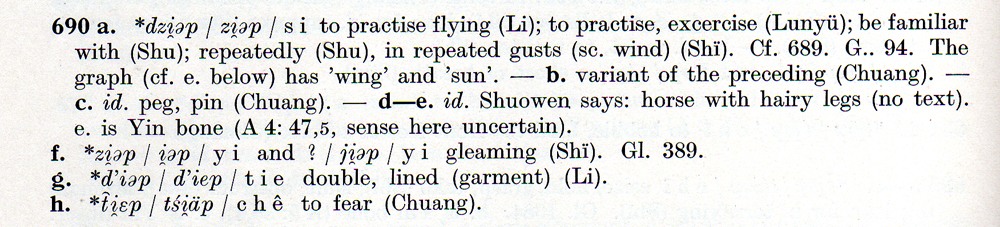
In the case of the meaning if xi Kargren gives meanings which are okay, as far as I'm concerned. But instead of just relying on the meanings that he gives it is better to check the character in the context that he gives. That gives you the opportunity to see if you agree with a specific meaning that he gives. Karlgren mentions the source for every meaning, and I think it is always a good thing to check that. It is very well possible that you don't agree with Karlgren's given meaning in the context or source that he gives. The GSR is quite easy obtainable as a reprint from SMC Publishing, by the way: http://www.smcbook.com.tw/search.php?textfield=karlgren Harmen. |
|
#53
|
||||
|
||||
|
Hi Harmen,
Gee, I have the 1957 reprint and went to the gates of hell to get it... Thanks for that link to the reprints!Now, down to business, since we are here to actually learn something and debate it if we have to, how would you interpret "xi2" within the context of the hexagram statement? L PS: I'll PM on a completely unrelated matter... |
|
#54
|
||||
|
||||
|
Oops, I almost forgot to reply to Bruce about how to show those files. Here is the code. You must have two versions of the same picture file, one a big version and the other is a thumbnail of the first. You upload both to your server and note the addresses. You then use the thumbnail version within the [IMG --- /IMG] code and wrap this one with a [URL --- /URL] code with the address of the big version, as follows:
HTML Code:
[url="http://www.yitoons.com/xi2-02.jpg"][IMG]http://www.yitoons.com/xi2-02-thumb.jpg[/IMG][/url] [url="http://www.yitoons.com/x12-01.jpg"][IMG]http://www.yitoons.com/x12-01-thumb.jpg[/IMG][/url] |
|
#55
|
||||
|
||||
|
Quote:
L |
|
#56
|
|||
|
|||
|
There is a particularity of water which people usually forget: it doesn't fill a space as a basin or a pit because it flows, it flows because it fills spaces...
Water is not in permanent flow looking for spaces to fill, water is pretty much quiet and settles immediately if no external factors set it in movement... Water also doesn't flow with intention or knowing where it goes, it is carried to places by diverse factors, but itself, it always tries to settle down... if you give this a thought, you may find more than K'an in K'an ![]() |
|
#57
|
|||
|
|||
|
Quote:
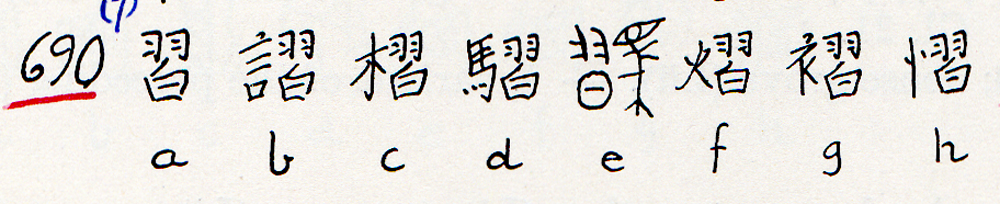
That is why I believe that 坎 means 'sound of drumming' instead of 'pit', because the repeating factor of 習 fits better the sound of drumming - is my opinion. This repeating is also found in the 3rd line, '來之坎坎', where 坎 is repeated. And we know from the Shijing that 坎坎 refers to the sound of drumming (I believe I also mentioned this somewhere else). Best, Harmen. |
|
#58
|
||||
|
||||
|
Thanks, Harmen,
Quote:
![]() L |
|
#59
|
||||
|
||||
|
Quote:
I use several digital dictionaries, that are easily accessible from the pages. You just hover your mouse over a character, and you get the meanings that I collected in my private dictionary. Clicking a character gives access to that private dictionary for editing, and several other dictionaries. So, I use no paper books. I suppose my way of handling this is a lot faster than using them, and makes it easier to have all kinds of views on contexts. |
|
#60
|
|||
|
|||
|
Quote:
For characters in oracle bone inscriptions I use
Harmen. Last edited by hmesker; July 9th, 2007 at 08:45 PM.. Reason: The occasions when I write 'there' instead of 'their' are numerous. |
![]() |
| Bookmarks |
| Thread Tools | |
| Display Modes | |
|
|
| All forum searches | Membership |