


 ]
]


 ___ H.1 KWS


Clarity,
Office 17622,
PO Box 6945,
London.
W1A 6US
United Kingdom
The problem of sequences of I Cing hexagrams in binary wheels, disks or necklaces was already viewed in the forun:
64 black+white beads contain all 64 hexagrams:
http://www.onlineclarity.co.uk/friends/showthread.php?t=5053&page=2
I ching on a string:
http://www.onlineclarity.co.uk/friends/showthread.php?t=5613&page=3
*NEW* 64bit Arrangement
http://www.onlineclarity.co.uk/friends/showthread.php?t=5212
Of course, the arrangement is not new in the sense that there were already objects and descriptions following the same idea.
The author of the last thread has developped extensively his arrangement in Abrahadabra Forum:
http://forums.abrahadabra.com/showthread.php?3277-64-bit-I-Ching-Binary-Loop-Wheel&p=40072#post40072
http://forums.abrahadabra.com/showthread.php?3277-64-bit-I-Ching-Binary-Loop-Wheel/page2&
He built the sequence begining with six yin-0 [000000] and adding sistematically yang-1 each time possible, only adds a yin-0 if otherwise will obtain a repeated hexagram.
Working with this method he obtains a unique solution, although wondering...
In fact this is one method for building a sequence of bits (yi/yang lines) that generates a wheel with the 64 hexagrams, reading six consecutive bits.
Another method would be to choose the opposite to the last bit whenever possible, say yin after yang and yang after yin. It will result another sequence.
There are many possible sequences, as you can see in the following quotes...
Memory wheels or de Bruijn sequences:
2048 with 4 bits, imagine with 6! >>> Sorry, I had to say five bits. Ch.
Did the chinese know these sequences?
Ver en Google Books
Sherman K. Stein:Mathematics: the man-made universe
See also:
http://hitxp.wordpress.com/2007/06/21/worlds-oldest-combinatoric-formula/
http://alexandria.tue.nl/repository/books/252901.pdf
I believe that chinese mathematicians didn´t know the sequences. Persons consulted don´t remember a circular arrangement similar to the posted in Abrahadabra.
Not strange if we think that the arrangement is not unique and that different diviners, by traying and error might have got different sequences all valid for its use. But for what use? Not for finding an hexagram in the Book of Changes, of course. Only for producing an hexagram by a quick method, like casting coins.
Maybe for personal use if a necklace or rosary of beads. Maybe for exhibition like a peculiarity, the multiplicity of results, given the lack of precise method maybe caused de low profile of the mechanism.
Yours,
Charly
64 black+white beads contain all 64 hexagrams:
http://www.onlineclarity.co.uk/friends/showthread.php?t=5053&page=2
I ching on a string:
http://www.onlineclarity.co.uk/friends/showthread.php?t=5613&page=3
*NEW* 64bit Arrangement
http://www.onlineclarity.co.uk/friends/showthread.php?t=5212
Of course, the arrangement is not new in the sense that there were already objects and descriptions following the same idea.
The author of the last thread has developped extensively his arrangement in Abrahadabra Forum:
http://forums.abrahadabra.com/showthread.php?3277-64-bit-I-Ching-Binary-Loop-Wheel&p=40072#post40072
http://forums.abrahadabra.com/showthread.php?3277-64-bit-I-Ching-Binary-Loop-Wheel/page2&
He built the sequence begining with six yin-0 [000000] and adding sistematically yang-1 each time possible, only adds a yin-0 if otherwise will obtain a repeated hexagram.
Working with this method he obtains a unique solution, although wondering...
I'm not sure myself how many unique solutions exist.
Unique being not reflected or inversed.
I can't think of another way to generate it myself, just the self referencing method I used.
Seems the Chinese did know about this arrangement:
http://www.onlineclarity.co.uk/frien...ead.php?t=5053
That is the only place I've ever seen it mentioned.
...
I Ching Code Wheel
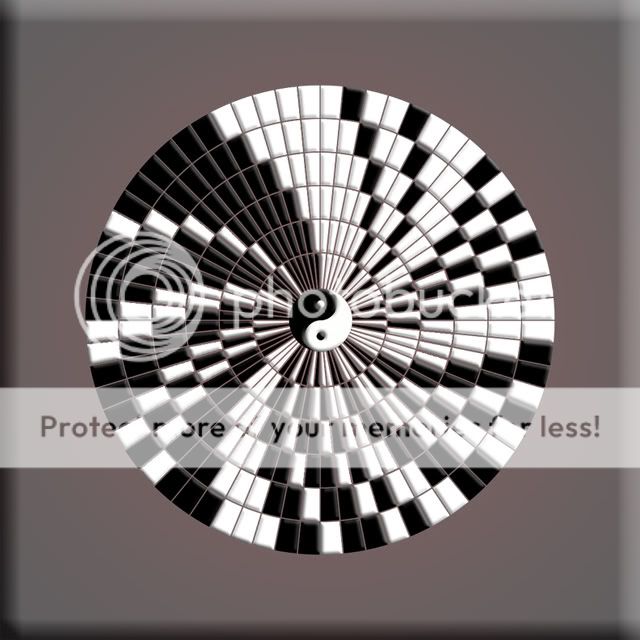
From;: http://forums.abrahadabra.com/showthread.php?3277-64-bit-I-Ching-Binary-Loop-Wheel/page2
In fact this is one method for building a sequence of bits (yi/yang lines) that generates a wheel with the 64 hexagrams, reading six consecutive bits.
Another method would be to choose the opposite to the last bit whenever possible, say yin after yang and yang after yin. It will result another sequence.
There are many possible sequences, as you can see in the following quotes...
Memory wheels or de Bruijn sequences:
The problem of constructing memory wheels is known as the rotating drum problem. The circular binary are often called lenght shift register sequences or de Bruijn sequences after the Dutch mathematician N.G. de Bruijn who wrote about them in 1946 (although it turned out that they had been constructed many years before by C. Flie Sainte-Marie). They have been used worldwide in telecomunications, and there have recen applications in biology.
Fig 4.18 page 84
Ian Anderson
A First Curse in Discrete Mathematics
2048 with 4 bits, imagine with 6! >>> Sorry, I had to say five bits. Ch.
In his study on memory wheels the Dutch engineer K.Posthumus found that there is exactly one wheel for binari cuplets, two for binary triplets, 16 for binary quadruplets (4 bits) and 2048 forr binary quintuplets (5 bits). <he then conjectured that there are 2^((2^n-1)-n) different memory wheels for binary n-tuples . In 1946 de Bruijn established his conjecture.
Thomas Koshy
Discrete mathematics with applications
Page 703
Did the chinese know these sequences?
Ver en Google Books
Sherman K. Stein:Mathematics: the man-made universe
Stein traced the first such memory wheel to India of about 1000 AD. The next use of a memory wheel was in France in 1882, where Emile Baudot used it for 32 quintuplet telegraphy. In this past century, memory wheels, also called de Bruijn cycles, have been used in a variety of applications, ranging from probability theory, coding, and communications.
Stein quotes the Sanskrit sutra, yamatarajabhanasalagam, which describes all possible triplets of short and long syllables, as evidence of the Indian knowledge of a memory wheel of length 3. Since Sanskrit metres are based on the system of short, laghu, and long, guru, syllables, represented traditionally by j and S (by us as 1 and 0), the sutra may be written as:
1000101110 which represents the sequences 100, 000, 001, 010, 101, 011, 111, 110
Subhash Kak
Yamatarajabhanasalagam: An Interesting Combinatoric Sutra
Indian Journal o history of Science
At: http://citeseerx.ist.psu.edu/viewdoc/download?doi=10.1.1.57.9025&rep=rep1&type=pdf
See also:
http://hitxp.wordpress.com/2007/06/21/worlds-oldest-combinatoric-formula/
http://alexandria.tue.nl/repository/books/252901.pdf
I believe that chinese mathematicians didn´t know the sequences. Persons consulted don´t remember a circular arrangement similar to the posted in Abrahadabra.
Not strange if we think that the arrangement is not unique and that different diviners, by traying and error might have got different sequences all valid for its use. But for what use? Not for finding an hexagram in the Book of Changes, of course. Only for producing an hexagram by a quick method, like casting coins.
Maybe for personal use if a necklace or rosary of beads. Maybe for exhibition like a peculiarity, the multiplicity of results, given the lack of precise method maybe caused de low profile of the mechanism.
Yours,
Charly
Last edited: